

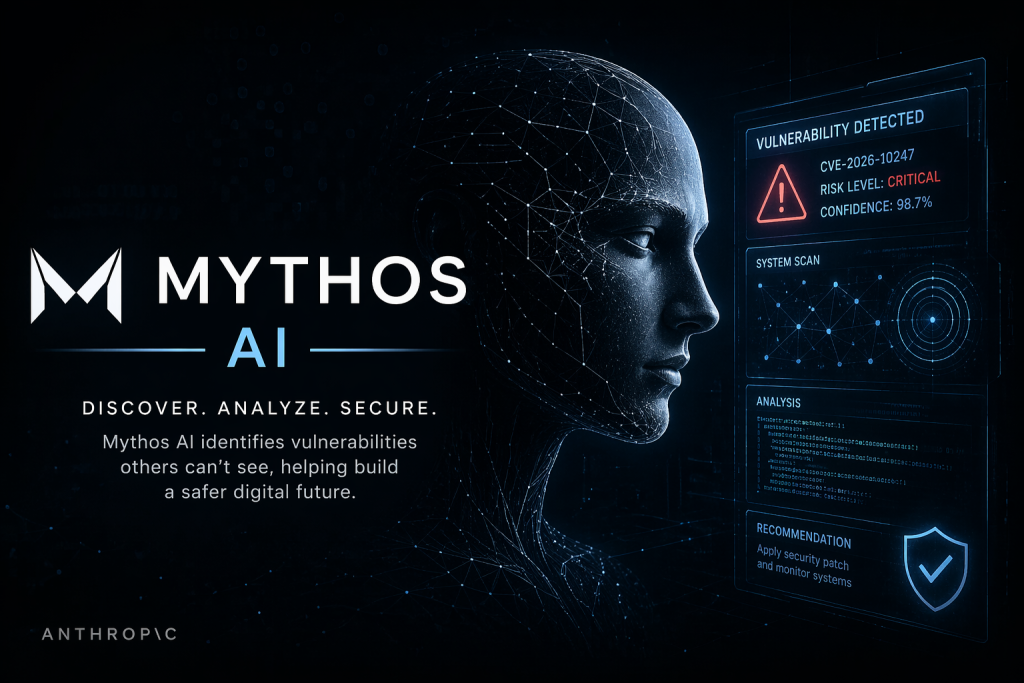
In the world of artificial intelligence, breakthroughs rarely arrive quietly. But every so often, something emerges that doesn’t just push boundaries, it redraws them entirely. That’s exactly what appears to be happening with Mythos, a next generation AI model developed by Anthropic and now reportedly being evaluated by one of the most controversial U.S. government agencies.
At first glance, this might sound like another incremental leap in AI capability. It isn’t.
Different Kind of Intelligence
Mythos isn’t just faster or more efficient than its predecessors. It represents what insiders describe as a step change in capability. Unlike conventional AI models that assist with tasks, Mythos appears to actively discover weaknesses in complex systems. In cybersecurity testing alone, it has reportedly identified thousands of high risk vulnerabilities across widely used software and platforms.
That kind of capability is a double edged sword.
On one hand, it could help organizations secure systems faster than ever before. On the other, it raises an uncomfortable question: what happens if tools like this fall into the wrong hands or are used without clear oversight?
Why Governments Are Paying Attention
Recent reports suggest that U.S. agencies are already experimenting with Mythos in controlled environments. This is significant for two reasons.
First, it highlights a growing divide within governments themselves, between those who see advanced AI as a strategic advantage and those who view it as a serious risk.
Second, it underscores a shift in how AI is being treated. We are moving from consumer technology to critical infrastructure. AI is no longer just powering chatbots and automation. It is influencing national security, financial stability, and global power dynamics.
The Risk No One Can Ignore
The concern is not theoretical.
Experts warn that systems like Mythos could identify and exploit zero day vulnerabilities, flaws that even software developers do not yet know exist, faster than they can be patched.
In high stakes sectors like banking or energy, that capability could be devastating if misused. Some analysts have even suggested the potential for widespread disruption across financial markets if such tools were weaponized.
Even Anthropic itself has acknowledged the risks, noting that technology of this scale could impact public safety and economic stability if not carefully controlled.
The Paradox of Progress
What makes this moment particularly complex is that Mythos was likely built with good intentions. Its core strength, identifying vulnerabilities, is exactly what the cybersecurity world needs.
But here is the paradox.
The more effective the tool becomes at defending systems, the more dangerous it becomes if turned against them.
This creates a tension that the tech industry and governments have never had to navigate at this scale. Regulation struggles to keep up, while innovation continues to accelerate.
A Glimpse Into the Future
What we are seeing with Mythos is not an isolated event. It is an early signal of a broader shift.
AI systems are becoming autonomous problem solvers, not just assistants.
The line between defense and offense in cybersecurity is becoming increasingly blurred.
Access to advanced AI is turning into a geopolitical issue, not just a commercial one.
In many ways, this mirrors earlier technological revolutions such as nuclear energy, the internet, and aviation. Each brought immense benefit, but also required new frameworks for control, ethics, and responsibility.
Mythos forces us to confront a simple but uncomfortable truth.
Technology is no longer just a tool we use. It is becoming a force we must manage.
The real challenge is not whether we can build more powerful AI. Clearly, we can.
The question is whether we can build the systems, safeguards, and discipline needed to control it.
Because in the age of AI like Mythos, the difference between progress and risk may come down to something far less technical and far more human. Judgment.